Critical Minerals Beneath the Nation’s Feet
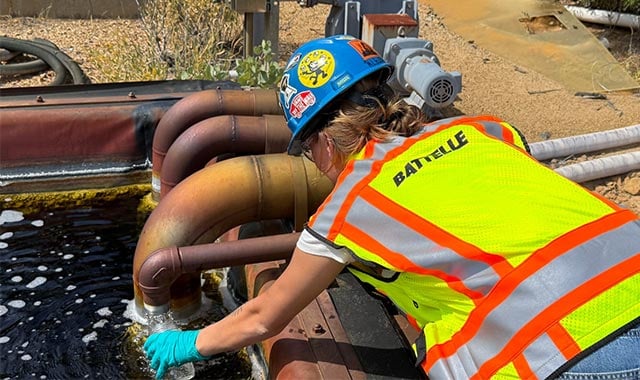
The United States is racing to secure the critical minerals that power modern life, minerals essential to national security, clean energy, advanced manufacturing and emerging technologies. While much of the focus has been on opening new mines or securing supplies overseas, one of America’s most accessible domestic resources has been hiding in plain sight.
Across the country, legacy mine waste, material left behind from decades of hard‑rock mining, contains valuable critical minerals that were once overlooked or technically impossible to recover. Today, those same minerals are strategically essential.
Unlocking them, however, requires more than policy ambition or investment. It requires trusted, independent science to demonstrate what works, where, and under real‑world conditions.
A Hidden Resource with National Importance
The scale of the opportunity is enormous. The Bureau of Land Management estimates there may be as many as 500,000 abandoned hard‑rock mines on public and private lands nationwide. Nearly 100 legacy mining and mineral processing sites are already on EPA’s Superfund National Priorities List, with many more undergoing cleanup.
These sites were originally mined for gold, copper, silver and lead. But minerals that are critical today, such as rare earth elements, cobalt, manganese, tellurium and germanium, were often left behind.
Research by the U.S. Geological Survey (USGS) and the Department of the Interior confirms the potential:
- At Idaho’s Coeur d’Alene mining district, legacy materials contain billions of dollars’ worth of minerals such as antimony and arsenic.
- At Oklahoma’s Tar Creek Superfund site, historic lead and zinc mining left waste rich in germanium and zinc, both heavily imported by the United States today.
- At Utah’s Bingham Canyon mine, USGS studies show that tellurium, vital for defense technologies and electronics, frequently ends up in mining tailings.
Despite this potential, the United States remains heavily dependent on foreign sources.
The Barriers Holding Recovery Back
Recovering critical minerals from mine waste is not simple. Several challenges have slowed progress:
- Lack of demonstration opportunities: Many recovery technologies are still at bench- or pilot- scale, in need of access to real mine waste materials for testing, de-risking and further advancing their technologies.
- Highly variable materials: Mine waste comes in many forms, tailings, waste rock, slags, contaminated soils and mining‑influenced water, each with its own chemistry and contaminants.
- Economic uncertainty: Traditional mining can take 15 years or more to reach production. Recovery from existing waste can move faster, but only if performance and economics are proven.
- Incomplete site data: Many legacy sites have yet to be thoroughly characterized for critical mineral content, making it hard to know where recovery makes sense.
Solving these challenges requires access to sites and materials and rigorous, independent assessment under real‑world conditions.
Enter EMRTAI: Turning Evidence into Action
That’s where the Environmental Monitoring and Remediation Technology Assessment Initiative (EMRTAI) comes in.
EMRTAI is an EPA‑funded initiative led by Battelle, the world’s largest independent non-profit applied science organization. Its goal is straightforward but powerful: generate independently validated performance data that regulators, investors, technology developers and communities can trust.
EMRTAI evaluates technologies using real mine waste from legacy sites across the United States. Assessments range from bench scale to pilot scale demonstrations, following rigorous intentionally designed quality assurance protocols with the needs of technology developers and potential technology users in mind.
Through its first two calls for applications, EMRTAI has already engaged eight technology developers. Since October 2025, assessments have been underway for recovering critical minerals from mining‑influenced water. At the same time, EMRTAI is testing whether handheld X‑ray fluorescence tools can reliably screen mine waste for critical minerals, technology that could dramatically accelerate site assessment nationwide.
Just as important, EMRTAI evaluates recovery alongside remediation. By characterization needs for contaminant treatment and residual waste materials, the initiative generates data that support both cleanup planning and resource recovery.
The result: actionable evidence that helps turn environmental liabilities into potential assets.
Why This Moment Matters
Mineral supply chains have become a national security issue. At the same time, decades of research confirm that valuable materials already sit at the surface, in places the country must clean up anyway.
Legacy mine waste may not replace traditional mining, but it can complement it, shorten timelines, and reduce risk.
By replacing uncertainty with evidence, EMRTAI is helping create credible pathways from remediation to recovery, one validated technology at a time.
Sometimes, the resources we need most aren’t buried deep underground. They’re already beneath our feet.
Learn more at emertai.org.
Related Blogs
BATTELLE UPDATES
Receive updates from Battelle for an all-access pass to the incredible work of Battelle researchers.