When Every Minute Counts: Medical Remote Sensing and the Future of Emergency Care
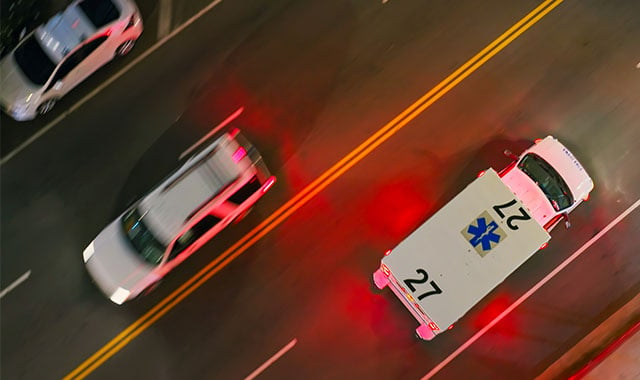
In a large-scale emergency, the first hour is the most critical, and often the most information-starved. First responders need to assess the scene quickly to determine who is hurt, how badly and who needs help first. But in a mass-casualty event, it may be challenging or impossible to get that information quickly enough to make a difference.
Medical remote sensing is beginning to change that. Contactless technologies that can read a patient's vital signs from a distance offer a way to assess many people at once, turning the chaotic first minutes of a response into a clearer picture of who needs help first.
The Information Gap in the Golden Hour
Emergency medicine has long recognized the golden hour: the first 60 minutes after a serious injury, when fast intervention can mean the difference between recovery and loss. The clock is the obvious enemy. But running alongside it is another problem—the information gap.
That gap is widest exactly when the stakes are highest. At a mass-casualty scene such as an earthquake, a building collapse or a multi-vehicle pileup, a handful of responders may face dozens of patients with no reliable way to determine who is critical and who can wait without reaching each person and assessing them individually. Supplies get dispatched before anyone knows what's needed or where. Triage itself becomes a bottleneck, because the act of sorting patients depends on a trained person physically getting to every one of them.
Recent advances have started to chip away at the problem from one direction. Autonomous drone delivery platforms have shown that critical supplies can reach remote or overwhelmed locations faster than any ground vehicle. But delivery only solves half the equation. Getting blood, a defibrillator or medication to a scene faster matters only if you know who needs it, what they need and how urgently. Without that, you're moving supplies quickly but blindly.
That’s where remote sensing comes in. Rather than requiring a responder to reach and evaluate each patient one at a time, contactless sensing technologies can detect and monitor many patients at once, from a distance, building a picture of the scene before the first responder makes physical contact. In the golden hour, the most urgent question is rarely a precise heart rate. It's the triage question: who is critical, who is stable and where should limited resources go first.
Reading the Patient from a Distance
How do you measure a heartbeat or breathing rate without touching the patient? Remote sensing relies on a handful of complementary technologies, each reading a different physical signal.
- Radar bounces radio waves off the body and reads subtle motion, including the rise and fall of breathing or even the faint vibration of a beating heart. Because it senses movement rather than light, it works in darkness and through smoke, clothing or light debris.
- Thermal imaging maps the heat the body gives off. It can locate living people quickly in low visibility, screen for fever, monitor respiration, and reveal circulatory clues invisible to the eye, including the temperature changes that signal a body under stress.
- Camera-based systems use ordinary video and computer vision to detect the subtle color shifts in skin as blood pulses beneath it, translating them into heart and breathing rates. Cameras also capture what the other sensors can't: whether a person is moving, responsive or slumped. They work best in good light and at a closer range.
These technologies can surface more than you might expect. These systems rely on AI and deep learning to translate subtle shifts in temperature, color or movement, often imperceptible to human senses, into meaningful clinical information. Thermal imaging, for example, can detect the drop in skin temperature that occurs when the body pulls blood away from the extremities during shock, an early warning that a patient who looks stable is quietly compensating. In one pediatric ICU study, deep learning applied to thermal video flagged hemodynamic shock up to six hours before it set in.
But no single sensor tells the whole story. Radar can struggle to separate one patient's signal from another's in a crowd. Thermal contrast fades in extreme heat. Cameras need decent light and a steady view. The real power comes from combining sensing technologies to provide a clearer, more trustworthy picture of each patient, built entirely from a distance.
Looking ahead, the same sensing that identifies who needs help could be linked directly to the response itself. Drone delivery platforms already deliver medical supplies today (carrying blood to remote clinics in Rwanda, for instance), but delivery is most powerful when it knows where to go. Pair real-time assessment with autonomous delivery, and a future emergency response could begin closing the loop by reading a scene from a distance and then directing the right help and the right resources to the patients who need them first.
Designing Medical Remote Sensing Systems for the Future of Care
The same sensing that can triage a disaster scene has a much broader future in everyday care. Contactless monitoring could also be used to monitor patient condition during ambulance transport, watch over patients in a crowded ER, flag a decline or a fall in a long-term care facility or help support in-home care, all without wires, cuffs or anything a patient has to wear or remember. Remote sensing data can be instantly transmitted to care teams so they have relevant clinical information before they see the patient.
Designing a medical remote sensing system that actually works for a specific use case means answering a specific set of questions first:
- Where will the sensor live? On a drone, fixed to a wall or ceiling, built into an ambulance bay?
- What range does it need to cover? Centimeters to meters away, or across a kilometer-square scene?
- What conditions must it tolerate? Darkness, weather, motion, signal interference?
- What does it need to measure, and how precisely? Are you looking for a rough triage signal or a clinical-grade vital sign?
Answering those questions is where our work begins. Our medical sensing expertise spans a full spectrum of contact-based and standoff sensors as well as advanced neurosensing technologies. We use that experience to help define the sensing requirements for a given use case, then build the system to meet them: adapting proven off-the-shelf sensors where they fit, combining modalities where a single one falls short, and developing new capabilities where nothing existing will do. That includes developing a drone-based remote sensing platform for emergency response under challenging field conditions.
That work requires more than sensors alone. Turning a faint signal into a reliable, actionable reading depends just as much on algorithm development and systems engineering. This is what makes a system hold up in the real world rather than only in the lab.
In the most critical moments of care, getting actionable information to first responders and caregivers can mean the difference between life and death. Remote sensing technologies are closing the information gap when every minute counts.
Learn more about our medical sensor capabilities.
Related Blogs
Rehabilitation Beyond the Clinic: How Autonomous Vagus Nerve Stimulation (VNS) Could Accelerate Stroke Recovery
Read More

BATTELLE UPDATES
Receive updates from Battelle for an all-access pass to the incredible work of Battelle researchers.