New Approach Methodologies (NAMs): From Promises to Trusted Decisions

To move NAMs from promising tools to trusted decision support, the field needs practical infrastructure for organizing evidence, defining context of use and comparing performance consistently.
New approach methodologies (NAMs) are advancing rapidly, generating human-relevant preclinical data that is attracting serious attention from industry, regulators and government research programs. Continued progress across cell-based systems, tissue models, microphysiological platforms and computational approaches is expanding where and how NAMs may contribute to research, product development and regulatory decision-making. Even with this progress, expectations and implementation approaches still vary by application, agency and evidentiary need.
For drug developers, regulators and public-sector programs investing in NAMs for drug development, toxicology, biodefense or public health preparedness, an important question remains: How do we know a NAM is performing as claimed for the decision it is intended to support?
The U.S. Food and Drug Administration has issued draft guidance describing general considerations for validating NAMs used in drug development, and organizations including the Interagency Coordinating Committee on the Validation of Alternative Methods and the European Medicines Agency have established frameworks or pathways for validation, qualification and regulatory interaction. These efforts provide important direction for NAM developers, sponsors and reviewers. Translating that direction into practice, however, requires a practical and repeatable system for defining what evidence is needed, evaluating whether a method meets its intended purpose, and documenting the basis for decisions. Building that implementation capability will be essential if NAMs are to move consistently from promising research tools to trusted components of development and regulatory programs.
Confidence: The Missing Piece in NAM Adoption
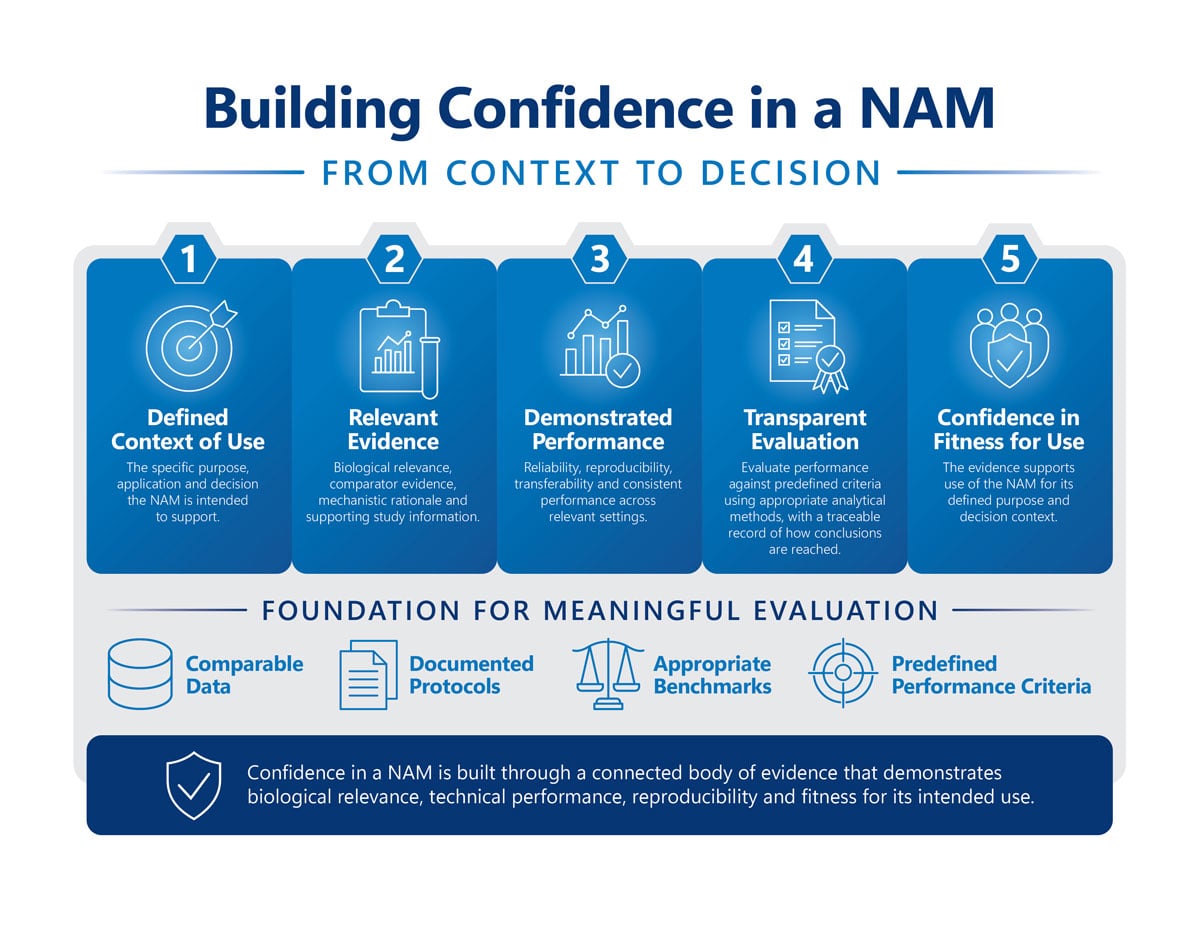
Broader adoption depends on confidence that a NAM measures what it is intended to measure, produces sufficiently consistent results and can inform a defined development or regulatory decision. That confidence is built through evidence that the method is reliable, relevant and fit for its intended context of use. The context of use defines the specific purpose, application and decision the method is expected to support. A method may be technically sophisticated and biologically relevant, but confidence ultimately depends on whether it produces reliable and interpretable results for that defined use.
The evidence required will therefore differ across applications. A respiratory model used to predict inhalation toxicity, for example, would require different endpoints, comparators and performance criteria than the same platform used to evaluate the efficacy of a therapeutic against a lung infection. The underlying model may be similar, but the claim being evaluated and the evidence needed to support it will be different.
This distinction is also important when discussing validation, qualification and regulatory acceptance. Validation establishes evidence that a method performs reliably for a defined purpose. Qualification is a formal determination that a method is suitable for a specified use in development. Regulatory acceptance concerns whether a regulator or other decision-maker will rely on the method and its results in practice.
Confidence in a NAM therefore depends on a connected body of evidence demonstrating biological relevance, technical performance, reproducibility and fitness for the intended use. These requirements help explain why NAM evaluation cannot be reduced to a single checklist or universal performance threshold. The relevant evidence and acceptable level of uncertainty must be aligned with the decision the NAM will inform. A method used for early-stage screening may be evaluated differently from one intended to support a safety determination, product development milestone or regulatory submission.
Why NAM Evaluation Is Difficult to Implement
Applying NAM validation principles consistently requires scientific rigor, effective data management, robust workflows and clear documentation. The evidence must also be interpreted in relation to a defined decision. Four connected challenges make this difficult in practice.
Data comparability, documentation and integrity.
NAM evaluation may draw on prior in vivo studies, other NAM datasets, reference compounds and evidence generated across multiple laboratories. Differences in protocols, endpoints, terminology and reporting formats can limit meaningful comparison. Data and metadata must be organized into a consistent structure, with sufficient documentation of protocols, controls, provenance and study quality to determine whether comparisons are appropriate.
Context-specific evidence requirements.
Translating a context of use into an evaluation plan requires selecting relevant endpoints, comparators, benchmarks and performance criteria. These requirements may differ across applications, agencies and stages of development. The challenge is to define an evidence package that is scientifically appropriate for the intended decision and sufficiently clear for developers, sponsors and reviewers to evaluate.
Biological and human relevance.
Demonstrating human relevance can be difficult when robust clinical reference data are limited or unavailable. Differences between NAM and in vivo results may reflect limitations of the NAM, limitations of the comparator or meaningful differences in biological relevance. Evaluation must consider whether the model adequately represents the tissues, disease states or populations relevant to its intended use.
Technical performance, reproducibility and transferability.
Performance depends on controls, assay variability, quality metrics, operating procedures and consistent execution. A method that performs well in its originating laboratory may still face adoption barriers if its outputs cannot be reproduced under comparable conditions or if the method cannot be transferred reliably to other laboratories.
These challenges are compounded when developers, sponsors, public-sector users and regulators use different terminology or expect different forms of evidence for similar claims. Addressing them requires coordinated expertise in biology, data harmonization, computational methods, benchmarking, regulatory science and reproducible workflow design.
Building a Practical Approach to NAM Evaluation
Addressing these challenges requires coordinated expertise across biology, translational science, data science, software engineering, regulatory science and quality. These capabilities must work together to define the intended use, organize supporting evidence, establish appropriate performance criteria and document how conclusions were reached.
A shared evidence environment can help connect studies, protocols, endpoints, metadata and reference datasets within a structured evaluation process. It can support consistent comparisons against relevant benchmarks and preserve a traceable record of the evidence, analyses and decisions. This infrastructure can complement laboratory studies, scientific judgment and engagement with regulators by making NAM evaluation more transparent, reproducible and reviewable.
Battelle's TruNAM Workbench
Battelle is applying these capabilities through TruNAM™, a growing NAM data ecosystem designed to connect evidence, models, analytical workflows and scientific expertise around a defined context of use. The current prototype provides core capabilities for integrating and exploring data, organizing evidence, executing analytical workflows and maintaining traceability. Ongoing development will expand TruNAM's ability to help users define the intended application and decision, identify relevant evidence and comparators, design appropriate studies, evaluate NAM performance and assemble traceable evidence for review.
Battelle's broader vision is for TruNAM to provide the connective digital layer for an end-to-end NAM ecosystem—linking existing evidence, computational assessment and new experimental data in a traceable environment. This ecosystem will help developers, sponsors and evaluators determine which NAMs are fit for a defined purpose, what additional evidence is needed, and which study should be conducted next. Battelle is engaging regulators, NAM developers, research sponsors and end users to refine priority applications and advance focused pilot efforts.
Connect with our team to learn more about Battelle's TruNAM workbench for NAM evaluation and validation support.
Related Blogs







BATTELLE UPDATES
Receive updates from Battelle for an all-access pass to the incredible work of Battelle researchers.