Rehabilitation Beyond the Clinic: How Autonomous Vagus Nerve Stimulation (VNS) Could Accelerate Stroke Recovery
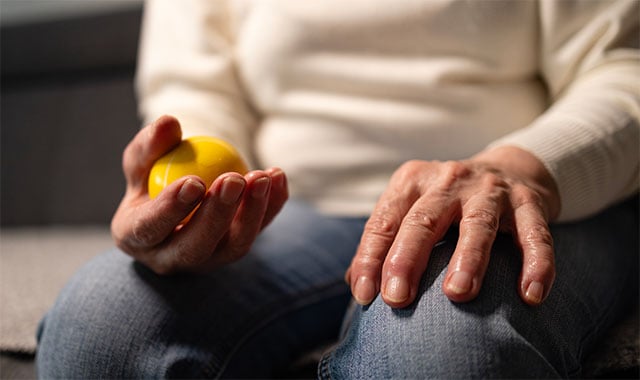
For stroke survivors, rehabilitation is not a short-term intervention. It is a sustained commitment measured in hours of therapy per week, repeated over months.
Vagus nerve stimulation (VNS) paired with movement attempts has shown real promise in accelerating motor recovery. But today, the therapy remains largely clinic-bound, dependent on a trained therapist manually triggering each stimulation event in real time. Battelle's medical device engineering team is developing a wearable system designed to bring autonomous VNS to patients at home.
What Keeps VNS Clinic-Bound
The vagus nerve runs from the brainstem through the neck and into the body, playing a key role in regulating the release of neurotransmitters associated with learning and memory. When the vagus nerve is stimulated at the precise moment a patient attempts a movement, it triggers a neurochemical response that reinforces the movement pattern the brain is trying to relearn. Over repeated pairings, that reinforcement accumulates, and motor recovery accelerates.
Timing, in this context, is critical. Stimulation that arrives too early, too late or independent of genuine movement effort does not produce the same neuroplastic effect. Today, ensuring that precision requires a therapist to be physically present for every session, watching for movement attempts and manually triggering stimulation each time one occurs.
That human-in-the-loop is what makes the therapy work. It is also what makes it expensive, access-limited and impossible to sustain outside a clinical setting. Most stroke survivors report ongoing deficits and unmet rehabilitation needs. For VNS, a therapy whose effectiveness depends on repeated, precisely timed sessions, the gap between what patients need and what the healthcare system can deliver is significant. More frequent, sustained stimulation paired with movement effort could improve motor function over time, but only if patients can actually access it consistently.
Replacing the Human Trigger: The Promise of Autonomous VNS
What if a stroke survivor could receive precisely timed VNS stimulation at home, during daily life, without a therapist in the room? That is the premise of semi-autonomous neurostimulation. Rather than relying on observation, the system reads the body directly.
Muscles produce electrical signals during movement attempts, even attempts that generate little or no visible motion. A wearable sensor captures those signals, algorithms interpret them in real time, and a detected movement attempt triggers stimulation automatically, with no manual intervention required.
The challenge for autonomous VNS is doing that reliably for the population that needs it most. After stroke, the engineering constraints are significant:
- Neuromuscular signals are often weak, inconsistent and highly variable from patient to patient
- A system calibrated to one person's signal profile may perform poorly for another's
- The device must be simple enough to use independently by someone with significant hand impairment
- It must perform consistently without technical support in an uncontrolled home environment
Meeting all of those requirements on a single wearable platform is the central engineering challenge in making autonomous, home-based VNS a reality.
Toward Autonomous VNS: A Wearable EMG Approach
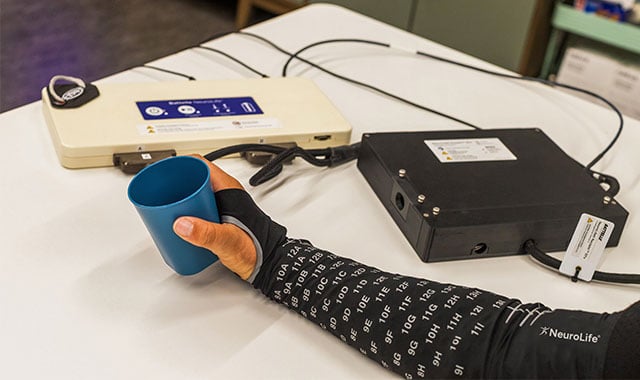
Addressing that challenge is the focus of an active development effort at Battelle, where a team of medical device engineers is building a wrist-worn EMG wearable designed to detect movement intent and trigger VNS automatically.
The system works as a four-stage pipeline:
- A wrist-worn EMG sensor captures electrical activity from the forearm muscles during movement attempts, including attempts that produce little or no visible motion
- Signal processing algorithms identify patterns consistent with intentional movement, drawing on machine learning models trained to each patient's individual EMG signature
- That detected intent becomes the trigger cue, determining when stimulation should be delivered
- The VNS system receives a wireless signal and responds automatically, in the moment effort occurs, without a therapist in the loop
The long-term vision is a fully closed-loop system that operates continuously throughout a patient's day, requiring nothing more than an initial calibration. Every reach, every grasp, every effort to open a door or pick up a cup becomes an opportunity for paired stimulation and the incremental neuroplastic change that, accumulated over weeks and months, can translate into meaningful recovery of function.
Battelle's engineers have spent more than a decade developing EMG-based systems for decoding movement intent, including work on sleeve-based platforms that paired neural signals with direct muscle stimulation to restore movement in people with paralysis. The autonomous VNS project builds on this work, translating established EMG decoding capability into a smaller, fully wireless platform that can perform consistently in the variable, uncontrolled conditions of daily home use. To make it work for this patient population, Battelle engineers had to solve for signals that are fainter and less consistent than those seen in other applications, build a system for patient calibration, and design a device that would be simple and accessible for people with significant physical impairment.
The device is now in patient testing with chronic stroke participants, with development supported in part by the NIH Blueprint MedTech Optimizer program, an initiative specifically designed to move promising neurotechnology toward commercial viability. While the immediate focus is chronic stroke, the underlying platform has potential applications in spinal cord injury and other conditions where movement intent can be detected and therapy paired to effort.
For the millions of patients who could benefit from more frequent and accessible rehabilitation, the goal is recovery that doesn't stop at the clinic door. Autonomous VNS is a meaningful step forward in continuous, home-based rehabilitation.
To learn more about Battelle's neurotechnology and medical device capabilities, connect with our team.
Related Blogs


BATTELLE UPDATES
Receive updates from Battelle for an all-access pass to the incredible work of Battelle researchers.