More Than a Model: Putting AI to Work in Medical Devices and Therapeutics
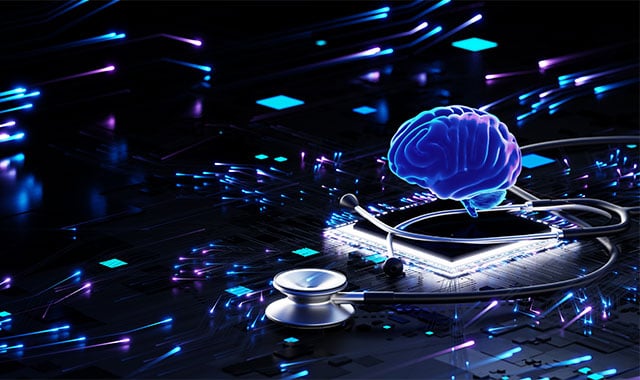
AI has become part of nearly every conversation in medical innovation. For most medical device and drug developers, the pressing questions now are where it fits and what it will take to make it perform.
A well-designed algorithm is essential, but it's only part of the answer. Whether AI delivers also depends on where the data comes from, how the model is built into a working system and whether it holds up when tested against the demands of its intended use.
At Battelle, we see AI at work in three distinct places: inside medical devices, in the way those devices are developed and in the search for new drugs and biologics. The potential payoff is more responsive care, better-informed design decisions and more focused discovery efforts.
Inside the Device
In a medical device, AI can take on very different jobs: interpreting the body's own signals, flagging findings for a clinician's review, adjusting therapy in real time or watching for early signs that a patient's condition is changing. Whatever the job, the algorithm has to perform outside the controlled conditions where it was developed. Real-world signals are noisy and vary from one patient to the next, and the model must run within the power, size and processing limits of the device itself. Validation has to match the stakes, too. A system that suggests a finding for review needs a different level of evidence than one that acts on its own.
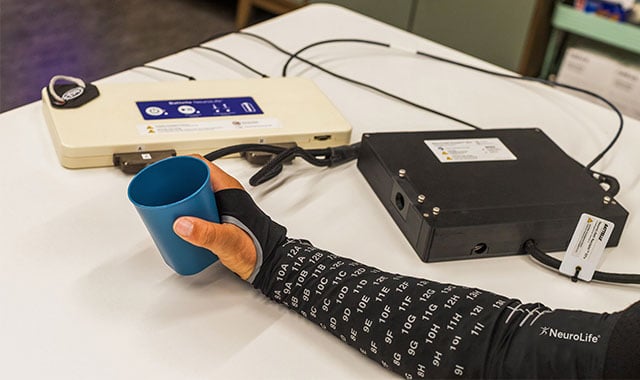
Our experience with device AI goes back more than a decade, to machine learning models that decode signals from the brain and muscles to identify what a person intends to do. In research settings, those models helped people with paralysis regain functional hand movement. Today our projects span that full range:
- Closed-loop therapy. With clinical and academic partners, we're developing a stroke rehabilitation wearable that reads a patient's muscle signals, recognizes the intent to move and triggers nerve stimulation at that moment. Models tuned to each patient are designed to bring a therapy that normally depends on a clinician into the home.
- Predictive monitoring. We've built triage models for mass-casualty care, from remote sensing in the field to hospital models that combine vital signs, waveforms, lab results and clinical assessments to anticipate what kind of care patients need and monitor changes in patient condition.
- Adaptive feedback. For people recovering from brain injury, we developed a camera-based system that recognizes everyday objects and tracks how a patient uses them, giving real-time feedback and adjusting difficulty based on the kind of error the patient makes.
Manufacturers can put that experience to work in their own products. We help them define what an AI-enabled function must accomplish for patients and clinicians, develop the algorithm and device together as a single system, then validate performance with evidence scaled to the device's risk.
On the Development Bench
AI is also changing how devices get built, speeding up the research and analysis that development runs on. In a regulated industry, though, design decisions have to be traceable and defensible. AI can surface options quickly, but every finding it contributes has to be verified before it shapes a design.
Our teams integrate AI tools at several points in medical device development. For example:
- Materials selection and discovery. Engineers use AI to search decades of Battelle materials research for candidates that meet requirements such as sterilization compatibility, chemical resistance, biocompatibility and wear. When new materials are needed, we can pair AI-suggested candidates with automated synthesis and high-throughput testing, feeding each round of results back into the model.
- Standards and risk research. AI helps identify the standards that apply to a design and mine public safety and complaint databases for real-world failure patterns that strengthen the risk management file.
- Test data analysis. AI-assisted tools turn large volumes of raw instrument output into usable analysis more quickly, so teams get answers while design decisions are still open.
These tools are only as good as the data they draw on and the expertise behind them. Our materials work taps into proprietary Battelle research on what was tried, what failed and why — knowledge that general-purpose AI models can't see. Every result also goes through engineers who can judge whether it would stand up in a design history file and, eventually, a regulatory submission.
For device developers, that means better-informed decisions earlier in the process, less time spent pursuing unsuitable options and stronger evidence behind the path forward.
In the Discovery Lab
In drug and biologic discovery, AI is being asked to narrow enormous design spaces, predicting which molecules, formulations or delivery vehicles are worth making at all. But a prediction is only a hypothesis until something is made and tested, and a model improves only when those results flow back into it. That makes the lab as important as the algorithm. The fastest progress comes from pairing AI-informed design with proprietary databases, automated synthesis and high-throughput testing, so each round of experiments teaches the model something new.
Our work in nonviral gene delivery shows that loop in practice. We built a platform technology that combines machine learning, automated polymer synthesis and high-throughput screening. Automated systems produce hundreds of candidate polymers in parallel, and models trained on every material we make predict which nanoparticle designs are most likely to reach their target cells. The approach has produced nanoparticles that delivered a large gene into neuronal cells in animal models, a gene too large for the viral vectors most commonly used in gene therapy. It's the same design-make-test loop behind our materials discovery work, applied to therapeutics.
For pharmaceutical companies, the value is in where lab time goes: toward the candidates most likely to work, with each experiment making the next prediction better.
Accelerating Device and Drug Innovation With AI
A strong algorithm is the starting point, but much of what makes AI useful is decided before and after the model is built. It starts with defining what an AI-enabled function has to accomplish and what evidence will show it does; these answers shape the data a team needs and how the model is designed. It continues as the model is built into a device or lab workflow and tested against the conditions it will actually face. That requires data scientists, engineers, lab scientists and regulatory specialists working together from the first design decision. Programs built that way give AI its best chance to speed device and drug innovation without introducing new risks or unexpected behaviors.
Battelle brings those disciplines together to help device and drug developers move from early concepts through validation to clinic-ready solutions. Because it takes more than an algorithm to bring innovation to patient care.
For more on this topic, watch Battelle’s webinar, Demystifying AI in Modern MedTech
Connect with a Battelle expert to talk about where AI fits in your program.
Related Blogs

Rehabilitation Beyond the Clinic: How Autonomous Vagus Nerve Stimulation (VNS) Could Accelerate Stroke Recovery
Read More



BATTELLE UPDATES
Receive updates from Battelle for an all-access pass to the incredible work of Battelle researchers.