4 Key Qualities to Look for In A PFAS Laboratory Testing Partner

PFAS data without the expertise to interpret it is just numbers, and expertise without robust, accurate data is just guesswork. When it comes to navigating the complex world of per- and polyfluoroalkyl substances (PFAS), you need both precision in the lab and insight outside of it. To get meaningful and defensible results, you need a lab that does more than run tests—you need one that understands PFAS.
Here’s what to look for when selecting a partner for PFAS laboratory analysis.
Four Qualities to Look for in a PFAS Laboratory Partner
PFAS testing is not a one-size-fits-all service, and not every analytical lab is equipped to do it right. A true PFAS laboratory brings together four critical components:
- Accreditations and certifications to meet regulatory guidance, including the Safe Drinking Water Act (SDWA) and the Unregulated Contaminant Monitoring Rule (UCMR)
- Advanced analytical technologies and capabilities like high-resolution mass spectrometry (HRMS) or comprehensive PFAS libraries
- Robust quality control measures, from documented quality assurance protocols to transparent reporting
- Technical expertise that guides strategic, risk-informed decision-making
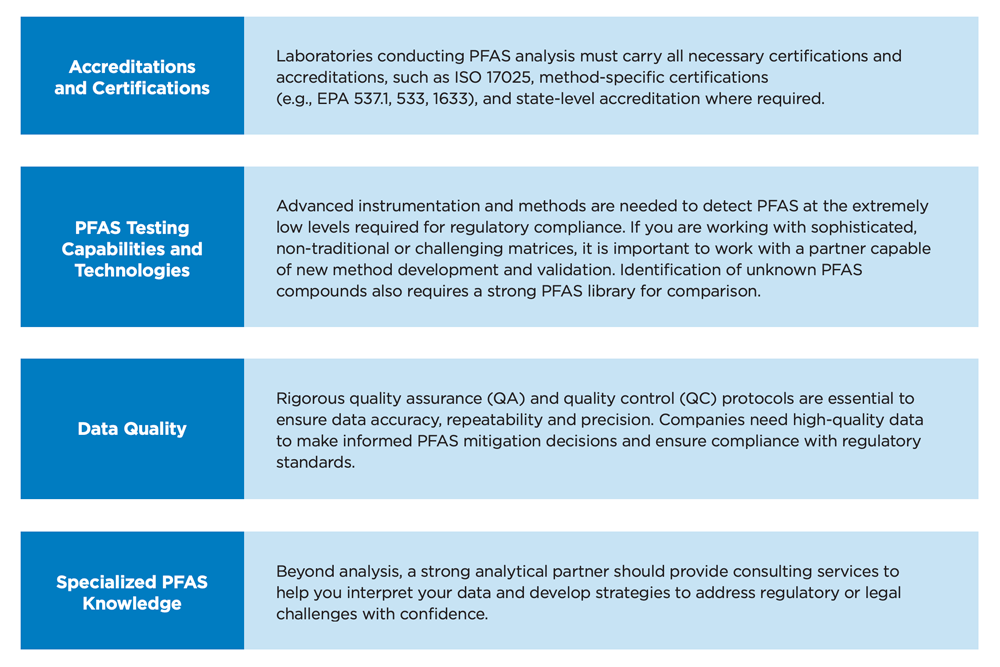
Look for these 4 qualities in a PFAS laboratory partner.
#1: Accreditations and Certifications
To meet state and federal requirements, the laboratory must hold formal accreditations and certifications that validate its methods and performance. These credentials ensure the lab operates under strict quality systems and is capable of producing data that meets specific detection limits, supports compliance, and protects human health.
- EPA Method Certifications (e.g., 537.1, 533, 8327, 1633): Demonstrate the lab’s ability to perform targeted analysis using approved test methods for PFAS in drinking water and other matrices like non-potable water.
- NELAP (National Environmental Laboratory Accreditation Program): Confirms the lab meets national standards for data quality objectives, documentation and analytical performance across diverse environmental matrices.
- DOE Accreditation: Required for Department of Energy-related testing, often involving PFAS in high-stakes contexts tied to environmental risk or legacy contamination.
- DOECAP (Department of Defense Environmental Data Quality Workgroup): Indicates the lab meets stringent DoD standards for PFAS analysis, often used for soil, sediment and water sampling at military or government sites.
- State-Level Certifications: Many states require their own approvals for PFAS testing in drinking water and other regulated materials. Labs should hold appropriate credentials for any jurisdictions they serve.
#2: Analytical Equipment and Capabilities
Because PFAS exists at extremely low concentrations—often at parts-per-trillion ranges—high-sensitivity instrumentation is critical. A qualified PFAS testing lab should be equipped with state-of-the-art instrumentation and have the ability to perform advanced analysis using techniques like:
- Liquid chromatography with tandem mass spectrometry (LC-MS/MS)
- High-resolution mass spectrometry (HRMS)
- Combustion ion chromatography (CIC) and PIGE
In addition to advanced instrumentation, leading laboratories also offer method development and validation services to support testing of novel, mixed or hard-to-characterize materials such as multilayered packaging, treated textiles, industrial waste streams or process water sources. These applications often fall outside the scope of existing EPA methods and require labs to adapt or create protocols that ensure accurate results.
A robust PFAS compound library is equally critical, especially for non-targeted or suspect screening. Battelle, for example, maintains a PFAS library with more than 600 compounds, allowing experts to accurately match and identify both well-characterized and emerging long and short chain PFAS compounds across a wide range of environmental matrices and product types.
#3: Commitment to Data Quality
PFAS data must be accurate, repeatable and defensible—especially when you’re preparing regulatory filings, evaluating product safety or developing mitigation strategies. That’s why your lab should follow stringent quality assurance/quality control (QA/QC) procedures aligned with your project’s data quality objectives.
Look for a lab with documented QA protocols, transparent reporting practices and experience delivering high-integrity results under regulatory scrutiny.
#4: Specialized PFAS Knowledge and Consultation
Accreditation and instrumentation ensure a lab can produce data, but expertise is what turns that data into action. The right PFAS laboratory testing partner provides more than just results; they offer the consultative insight needed to select the right methods, interpret the findings and build a PFAS testing strategy that meets your goals in the most time- and cost-efficient manner possible.
Whether you’re developing a compliance strategy, responding to a potential PFAS contamination event or investigating your supply chain, having access to scientists who understand the full PFAS landscape makes all the difference.
Battelle: More Than Just a Testing Lab, It’s a Partner You Can Trust
At Battelle, we combine nearly two decades of experience in PFAS research and analysis with the technical capabilities of a leading-edge PFAS testing laboratory. As the first laboratory accredited to test for PFAS in 2016, we’ve continued to lead the way in method development, validation and expansion across a wide range of environmental media and challenging sample types.
We go beyond basic lab work - Our team helps you define a PFAS testing strategy aligned to your goals, with a service-first, quality-always attitude. Whether you’re addressing compliance requirements, implementing PFAS monitoring technologies, investigating product safety, or responding to PFAS contamination, we tailor our testing approach to your specific matrices, detection limits and regulatory context to ensure meaningful, defensible results.
And when the data comes back? As your trusted partner, we don’t just send a report. We help you interpret it, understand what it means for your organization and prepare for the next step—whether that’s personalized solutions, regulatory reporting, product reformulation or risk mitigation planning.
Ready to learn more? Download our white paper to explore PFAS testing strategies, EPA methods and how to choose the right approach for your requirements: A Strategic Approach to PFAS Analysis.
Frequently Asked Questions
PFAS compounds are chemically stable, environmentally persistent and often present at extremely low concentrations, requiring specialized PFAS analytical methods, equipment, and contamination controls that many standard laboratories aren’t equipped to provide. To deliver accurate, defensible results across diverse environmental and industrial matrices, analyzing PFAS requires:
- Specialized laboratory instrumentation
- Validated testing methods
- Deep analytical chemistry expertise
Related Blogs


PFAS in Semiconductor Manufacturing: Why “Forever Chemicals” Are Becoming a Strategic Challenge
Read More


-blog-hero.jpg?sfvrsn=963fba16_1)
BATTELLE UPDATES
Receive updates from Battelle for an all-access pass to the incredible work of Battelle researchers.