Change Chemistry: Reimagining the Future of Safe, Sustainable Chemistry
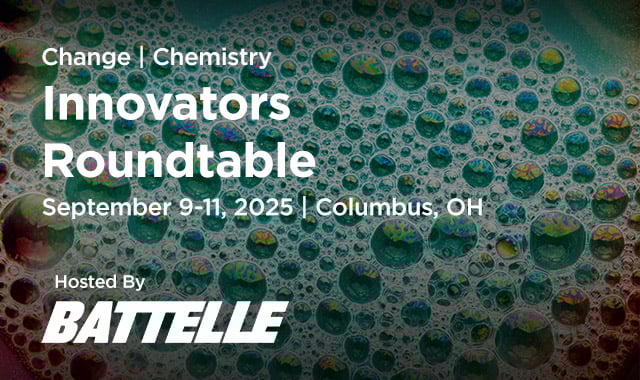
On September 9-11, Battelle will host the Change Chemistry Innovators Roundtable event in Columbus, OH, to convene members, partners and thought leaders for two days of collaboration, innovation and bold vision-setting.
In an era of accelerating challenges, shifting consumer expectations and rapidly evolving regulatory landscapes, the global call for a new model of chemistry has never been louder or more urgent. Change Chemistry, formerly known as the Green Chemistry and Commerce Council (GC3), is answering that call with clarity, purpose and collective force.
A Legacy of Leadership in Sustainable Chemistry
Founded in 2005 by Dr. Joel Tickner, a professor of public health at UMass Lowell, he explained that “Change Chemistry was born out of a simple but powerful realization: it’s not enough to identify and restrict harmful chemicals; we must also create and scale better alternatives.” Early in his career, Dr. Tickner recognized that companies across sectors faced similar barriers, incumbent chemicals were effective and cost-efficient, and there was little incentive to switch. Overcoming these market barriers requires unprecedented collaboration along the supply chain.
What began as a small gathering of companies has since evolved into a dynamic, independent business association. In 2020, Change Chemistry spun out from UMass Lowell, expanding its reach and impact. Today, the organization brings together a diverse membership, comprising global retailers and manufacturers, innovative startups and academic institutions, united by a shared commitment to safer and more sustainable chemistry.
Advancing a New Model of Chemistry
At its core, Change Chemistry’s purpose is to accelerate the commercialization and adoption of sustainable chemistry solutions. This means championing chemical design that eliminates hazardous substances, promotes renewable feedstocks, enhances material efficiency and reduces lifecycle impacts.
One of the most significant evolutions has been the inclusion of startups. “Startups bring energy and innovation,” says Dr. Tickner. By integrating these frontrunners into the network, Change Chemistry has created a space where new ideas can flourish, and established companies can discover cutting-edge solutions.
This diversity of membership, spanning sectors, geographies and company sizes, has become both a strength and a challenge, as Program Director Jennifer MacKellar explains. “Our strength is also our challenge: bringing together companies from across the value chain to address the challenge of bringing safer and sustainable chemicals to market. The chemistry challenges our members face are incredibly varied; what works as a solution in one sector may not be applicable in another. Our members include individuals from diverse corporate functions, such as R&D, sustainability and procurement, which makes it challenging to cater to everyone’s needs with a one-size-fits-all approach. However, we’ve been able to engage with 18 major retailers, representing trillions of dollars of purchasing power. That collective influence is a powerful driver for market change and helps us move the needle toward safer, more sustainable chemistry.”
The organization’s reach has also expanded internationally, particularly in Europe, where large retailers impact market forces.
Collaboration as a Catalyst for Change
Innovation is accelerating. New materials, cleaner production methods, digital chemistry tools and AI-driven discovery are opening the door to breakthroughs once thought impossible.
A hallmark of Change Chemistry’s approach is its emphasis on pre-competitive collaboration. In this context, sustainable chemistry is no longer a “nice-to-have”; it’s a strategic imperative. The companies that embrace it will lead the markets of tomorrow. And Change Chemistry offers a powerful platform to help them do just that.
“Change Chemistry’s journey over the past two decades reflects the shifting landscape of sustainable chemical innovation through partnerships and collaboration.” Explained Shalene Thomas, Senior Emerging Contaminants Program Manager at Battelle.
The organization has pioneered multi-stakeholder initiatives, such as the collaborative innovation challenge for safe and effective preservatives, which brought together retailers, brands and chemical suppliers to solve shared problems. These efforts have demonstrated that companies are willing and eager to collaborate, sharing knowledge and reducing costs to accelerate progress.
Why Battelle? Building an Ecosystem for Impact
Battelle’s longstanding engagement with Change Chemistry makes it a natural partner for this year’s event. As Dr. Tickner notes, “Battelle brings deep expertise in chemistry and a mission-driven purpose that is uniquely positioned to help advance sustainable chemistry even further.”
The partnership reflects an ecosystem approach, recognizing that research institutions and industry can drive meaningful change by working together.
Jennifer MacKellar adds, “Being part of a collaborative, forward-looking network is critical. The more people we have at the table, the more we can drive change towards safer and more sustainable chemistry.”
Join the Conversation
The upcoming Change Chemistry event at Battelle is more than a conference; it’s a call to action. The need for collaboration, innovation and leadership has never been greater. Whether you’re a manufacturer, retailer, startup or researcher, your voice and expertise are needed.
To join the upcoming Innovators Round Table event at Battelle, visit https://member.changechemistry.org/events/2025-innovators-roundtable.
To learn more about Change Chemistry and membership opportunities, visit https://member.changechemistry.org/.
Related Blogs


PFAS in Semiconductor Manufacturing: Why “Forever Chemicals” Are Becoming a Strategic Challenge
Read More

-blog-hero.jpg?sfvrsn=963fba16_1)
BATTELLE UPDATES
Receive updates from Battelle for an all-access pass to the incredible work of Battelle researchers.