Monitoring Long-Term Plume Growth in a CCS Sequestration Well
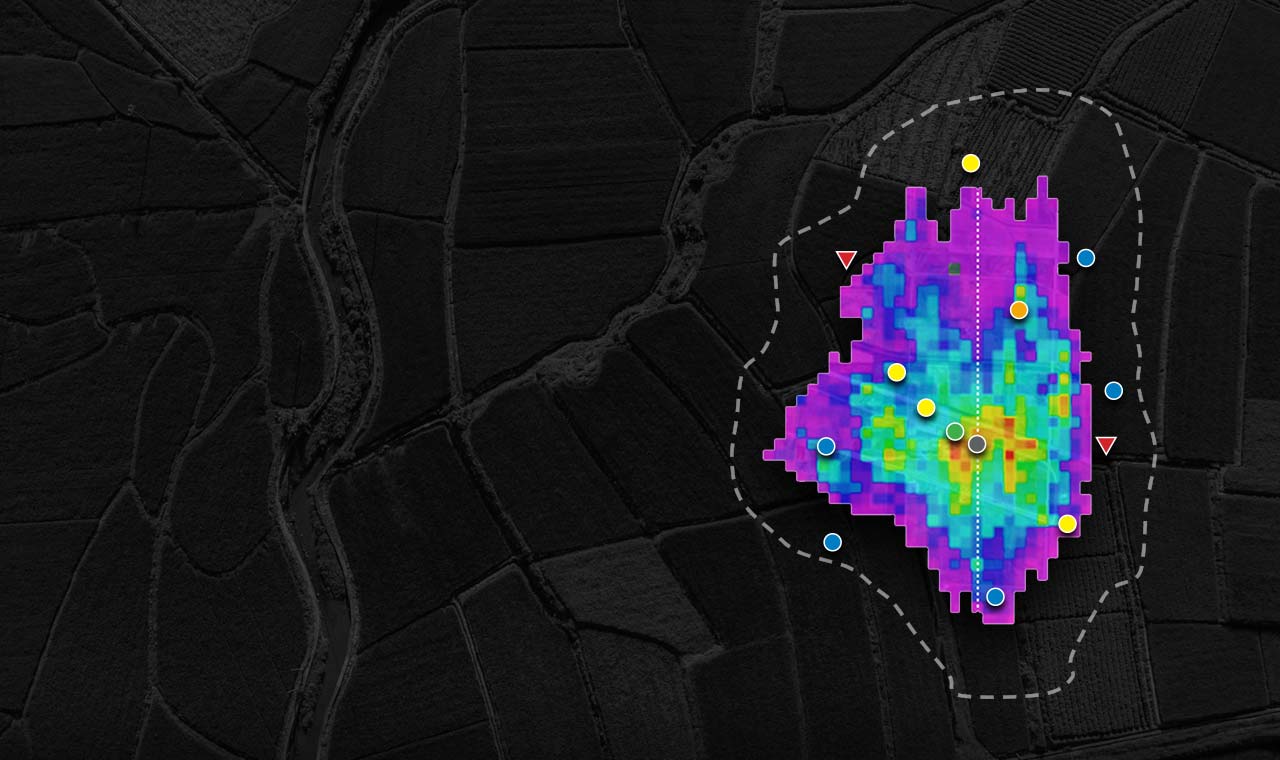
Once injection has begun at a carbon capture and storage (CCS) sequestration well site, protecting underground sources of drinking water requires thorough monitoring of the containment area and an accurate data picture of the carbon dioxide plume deep beneath the surface.
CCS provides a means of decreasing greenhouse gas emissions by separating CO₂ from other emitted gases at the source, compressing it into a liquid-like state, and injecting it deep underground. These Class VI sequestration wells have both a long operational life – up to 30 years – and need long-term Post-Injection Site Care (PISC) for up to a century after injection ends.
A key part of maintaining compliance with the U.S. Environmental Protection Agency's Underground Injection Control program regulations is tracking the growth of the carbon dioxide plume over these extended time periods. This can be achieved through a few approaches to active seismic monitoring or various alternative verification monitoring methods.
Surface Acquisition and Imaging
Active seismic monitoring utilizes time-lapse seismic surveys to image the changes in the subsurface caused by the injected CO2. The density difference between CO2 and water can be imaged with seismic waves and the CO2 plume becomes visible as CO2 accumulates in the reservoir.
Surface seismic utilizes a seismic source and receiver placed in a known pattern on the ground. A 2D survey requires receivers to be laid out in straight lines on the surface while 3D seismic relies on a grid of receivers spreads across the survey area. Surface acquisition approaches can generate useful and effective two- or three-dimensional seismic images, although they do require fluid substitution modeling of the site, and the surface conditions need to remain constant between surveys.
It's important to note that 3D seismic imaging is more time-consuming and costly than 2D – perhaps carrying a price tag nearly 10 times greater. (Think a few million dollars versus several hundred thousand.) It's also more invasive to landowners in terms of the number of sensors needed across the site.
Borehole Seismic
Borehole seismic measuring technology takes a different approach, creating vertical seismic profile (VSP) surveys through receivers in the wellbore to gather data from generated seismic waves generated at the surface. The seismic receivers can be permanent or temporary, but you may need to take into consideration any nearby seismic activity from heavy machinery like agricultural equipment or manufacturing plants. Borehole seismic offers the advantage of an improved signal to noise ratio and less surface impact.
VSPs also vary in complexity, time, and cost.
- A Zero Offset VSP uses a single seismic source positioned close to the top of the borehole. The most cost-effective option, providing the least amount of detail.
- An Offset VSP also uses a single seismic source, but positions it farther from the wellhead, providing complete 2D coverage on one side of the well.
- A Walkaway VSP incorporates multiple source positions on either side of the well arranged in a line for 2D coverage on both sides.
- A 3D VSP involves placing multiple seismic sources around the well, and provides the most depth of information.
Fiber-optic Distributed Acoustic Sensor (DAS) arrays are a proven option for VSP surveys, and can also lay the groundwork for 3D imaging and comparative 4D (time-lapse) surveys; although, again, this can get significantly more expensive.
Alternative Verification Methods
Every sequestration well site is different, and various factors that could prevent the use of seismic monitoring to track plume development. Several alternative methods are available.
For example, time-lapse gravity monitoring employs sensors capable of detecting the small gravitational changes which occur as CO2 displaces water in the containment reservoir. Another method, Interferometric Synthetic Aperture Radar (InSAR), uses satellite-based radar to monitor the surface for small deformations in the earth resulting from CO₂ injection.
There are also two different means which utilize strategically placed wells at the site to send and receive signals to build an image of the plume. Crosswell electromagnetic measurement measures feedback from injected current, while crosswell seismic measures feedback from injected seismic waves.
Fully Integrated Monitoring
A complete system for plume monitoring and other long-term aspects of PISC should integrate all the necessary measuring equipment and generate the full package of data needed for safe operation and protection of water sources. Battelle's CarbonEye™ monitoring technology is deployment-ready, and can incorporate InSAR-enabled surface deformation monitoring as well as a Novel Active Seismic source designed for permanent installation. CarbonEye can implement technology utilize technology that is used by the U.S. National Science Foundation's National Ecological Observatory Network (NEON), which monitors ecosystems across the U.S. Dig in and learn more in our white paper, “Compliance Monitoring for Carbon Sequestration.”
Frequently Asked Questions
Related Blogs
Powering the Future: A Conversation with Andy Griffith on Nuclear Energy’s Role in the World
Read More


BATTELLE UPDATES
Receive updates from Battelle for an all-access pass to the incredible work of Battelle researchers.