AI: The New Partner in Medical Device Development

There is a lot of buzz in the technology sector today. Seemingly daily there are breakthroughs of new tools, capabilities, and benchmarks for performance. There is a proliferation of available tools and playgrounds, and companies are scrambling to figure out how to leverage them.
The current benefits of artificial intelligence (AI) include optimizing processes, improving decision-making, and reaching unprecedented levels of efficiency with minimal infrastructural costs. We're seeing widespread corporate adoption of in-house AI platforms like Chat-GPT, DALL-E, and subscription-based tools like Adobe Photoshop.
The medical device industry is no exception. Keep reading to learn how AI technologies evolved throughout the years, how Battelle used (and is using) machine learning (ML) and AI to develop life-changing medical devices, and how to responsibly advance medical device innovation in the "AI Age".
The Evolution of AI
The Age of AI is upon us, and it’s transforming how we work and the digital health products that we create and use. We are in a state of rapid evolution, climbing the exponential curve. The evolution of AI in medical device development has been a remarkable journey. To understand the current state of AI, let's first take a step back and explore how we got here.
The Code Age
The journey began in the 1990s, in the "Code Age," when microprocessors and embedded code grew rapidly. Devices became smaller and more affordable, and cellular networks made mobile phones mainstream.
The Cloud Age
This adoption of micro processing and code set the stage for the the "Cloud Age" in the 2000s. High-speed internet access became the norm, and companies like Amazon and Google invested heavily in their data center and cloud computing offerings.
The Algorithm Age
The 2010s brought the "Algorithm Age," where we saw adoption of data science start to increase, largely because of advancements in computing power and the creation of large datasets. Bringing implications for medical imaging technology, revolutionary breakthroughs in Neural Network Models and other Deep Learning Models were made, transforming medical imaging technology like never before.
Notable advances in the "Algorithm Age" included:
- Computer vision
- Image classification
- Predictive modeling
The AI Age
Today, in the "AI Age", computing power can finally handle our large data sets to infer meaningful insights quickly. AI algorithm training methods are advancing before our eyes, fueled by market competition, including open source. Assistive AI tools via websites and Application Programming Interfaces (APIs) are broadly available and access continues to increase daily.

Our AI and Medical Devices Journey
Battelle has been involved in a wide variety of projects, from the commercially practical to those that push the boundaries of science and our knowledge of what is possible. AI has been (and will continue to be) integral in some of our most innovative medical technologies.
To summarize the evolution of developing medical devices with AI, we started with humans in the loop, graduated to an AI-assisted loop, and are now working towards closed-loop – autonomous AI.
Let's explore our journey with AI and medical devices.
Restoration and Rehab with Deep Learning
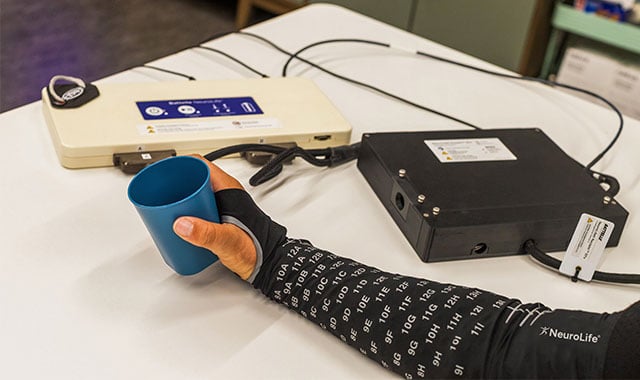
Over a decade ago, we started a project called Battelle NeuroLife® aimed at enabling tetraplegic individuals to regain their intended hand movements, effectively bypassing their spinal cord injuries. Through pioneering deep learning models, we achieved numerous technical breakthroughs and clinical successes in decoding the human nervous system and applying muscle stimulation to restore motor functions.
About the Battelle NeuroLife® Technology
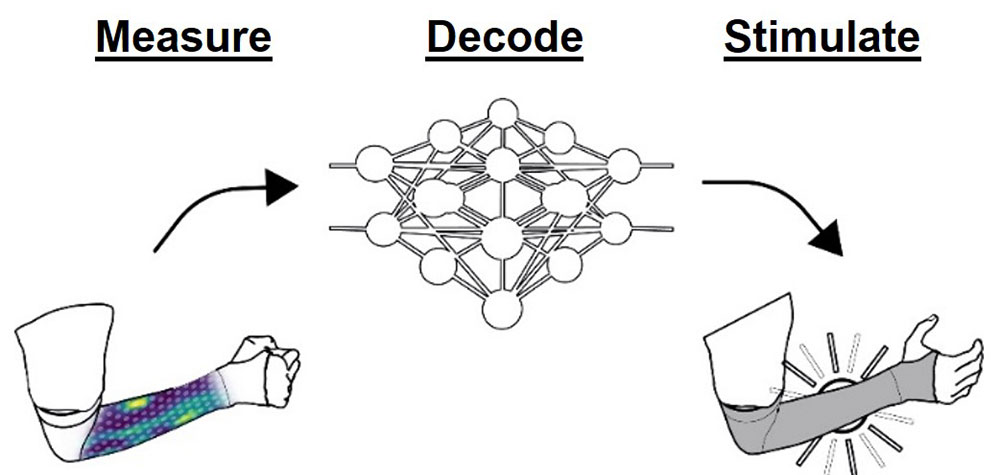
How the Battelle NeuroLife® sleeve works.
More recently, we deployed our knowledge, techniques, and algorithms in a non-invasive means to read and write neural signals in the forearm of stroke survivors during rehabilitation. We aim to create a tool that seamlessly integrates their rehabilitation with their daily activities.
Read more about our new approach to stroke rehabilitation in our blog "NeuroLife® Sleeve Brings New Approach to Stroke Rehabilitation".
Detecting Kidney Failure with Machine Learning
We also leveraged our machine learning expertise to tackle the challenge of early detection of acute kidney failure. By integrating an advanced machine learning tool with a hospital’s electronic health records (EHR) system, we successfully predicted the onset of kidney failure with 96% accuracy 24 hours in advance. This breakthrough has the potential to significantly improve patient outcomes by allowing for earlier interventions.

Kidney failure detection tool developed by Battelle.
Delivering Drugs with Artificial Intelligence
Now, we're employing artificial intelligence and machine learning to develop nanoparticles that target internal organs, for the delivery of gene therapies. These advancements hold the promise of highly personalized medicine and could revolutionize treatment protocols, including all but eliminating side effects from drug delivery.
Discover how we're advancing gene therapy in our blog "Delivering the Promise of Gene Therapy".
Transforming Tomorrow's Emergency Care
Looking ahead, we aim to transform emergency medical services by developing autonomous systems capable of casualty location, triage, stabilization, and airlift transport. These technologies are poised to dramatically improve response times and outcomes in rural accidents, military operations, and natural disasters.
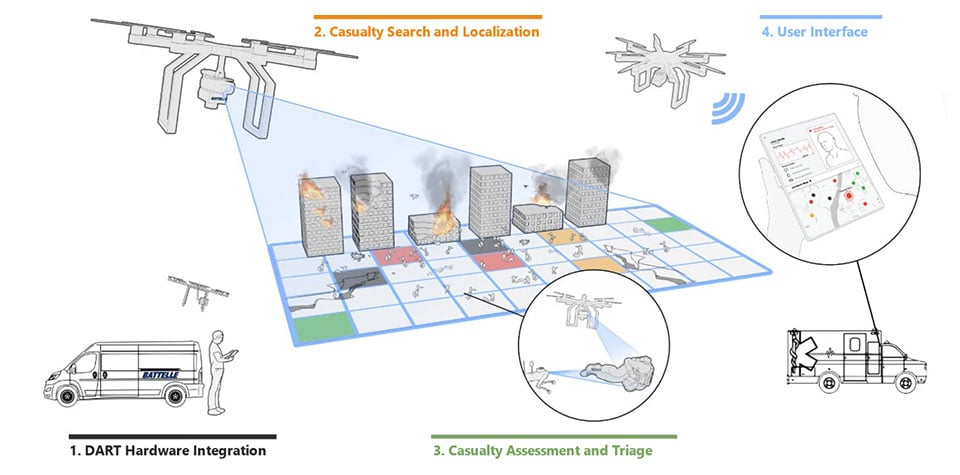
Model of Battelle's mass casualty triage system.
Image Credit: Emma Coughlin and Russ Kittel
See how we're tackling mass casualty triage for the Defense Advanced Research Projects Agency (DARPA) in our blog "Tackling the Challenge of Mass Casualty Triage with Technology".
AI and Medical Devices: Moving Forward
Using AI, we can create practical solutions for today and dream up the seemingly impossible for tomorrow. As we move forward, we must continue to focus on how users play a role in the function of AI-enabled medical devices, from medical professionals to patients.
We must also stay abreast of policies and positions of medical device regulators like the U.S. Food and Drug Administration (FDA) and the Association for the Advancement of Medical Instrumentation (AAMI). We have crossed into the next great industrial revolution and it's up to our community to work together, not just on our projects, but for the community's benefit.
Integrating medical device development and AI is not just a trend, but a transformative shift reshaping the patient care and device manufacturing landscape. At Battelle, we are not just observers of this shift, but active participants and pioneers. Our journey has led to remarkable breakthroughs and we continue to push the boundaries of what's possible.
The Battelle Advantage
With a focus on the real-world user and a deep understanding of regulatory landscapes, Battelle's Medical Device team is an ideal partner in leveraging the power of AI for medical device development. From technical questions to new (and on-going) projects, we're here to help! Get in touch with our experts today to get started.
Related Blogs

Rehabilitation Beyond the Clinic: How Autonomous Vagus Nerve Stimulation (VNS) Could Accelerate Stroke Recovery
Read More




BATTELLE UPDATES
Receive updates from Battelle for an all-access pass to the incredible work of Battelle researchers.