Advancing PFAS Destruction Solutions: Key Insights from Battelle's Hill Forum
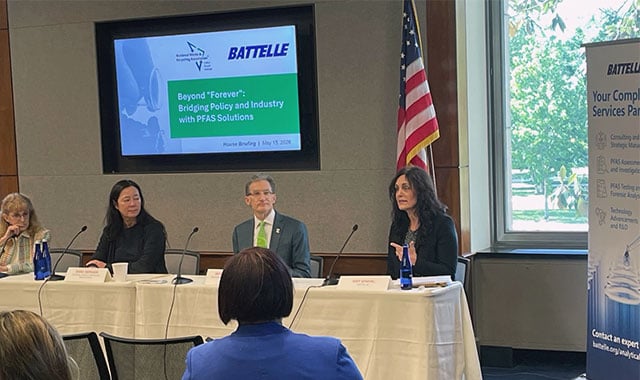
"Forever chemicals" including polyfluoroalkyl substances (PFAS), demand urgent action and the right solutions to destroy them. On May 14 and 15, 2026, Battelle co-sponsored "Beyond Forever: Bridging Policy and Industry with PFAS Solutions," convening policymakers and industry experts across two sessions on Capitol Hill. Senate staffers gathered May 14, House staffers May 15, engaging directly with a panel of experts navigating the complex intersection of PFAS science, regulation and real-world implementation. Panelists included Ben Grumbles, Executive Director of ECOS (Environmental Council of States); Anne Germain from our co-sponsor the National Waste & Recycling Association; and Amy Dindal, Director of the Battelle Environment and Agriculture business.
We sat down with Amy Dindal and Jeff Rose, VP of Government Affairs at Battelle, to unpack this important conversation about PFAS policy and solutions.
Why did Battelle sponsor the PFAS Hill Forum?
Jeff: We sponsored this Forum to provide congressional staff with objective, science-based insights where policy is still catching up with technology, and to convene a balanced set of experts who can help differentiate solutions based on real-world performance.
Amy: Battelle has been bringing real solutions through technology development to address society's challenges for over 96 years. Discussing PFAS destruction technologies and providing expert perspectives can help inform where Congress focus is needed in expediting solutions.
What made this gathering particularly significant?
Jeff: We had very engaged staffers asking thoughtful questions throughout both sessions. Several staffers who were actively working on PFAS legislation came and asked questions, wanting to bounce ideas off us. It provided a forum for real dialogue around how they could take information and apply it to bring legislative solutions on behalf of their constituents and committees.
Amy, you mentioned the panel brought three unique perspectives. What were they?
Amy: I represented technology and innovation, understanding current solutions and bringing new ones forward. Ben Grumbles brought the state perspective, which is critical because states are often dealing firsthand with challenges as real-world users and trying to balance federal versus state legislation. Anne Germain provided the ‘passive receiver’ perspective, entities like landfills and recycling centers. As she emphasized, they don't make PFAS and they don't use it, but they're receiving incoming material and facing possible long-term risk and financial liability.
Speaking of state perspectives, Ben Grumbles, Executive Director of ECOS, raised some critical concerns. What resonated most?
Jeff: Ben was very clear about what states need to move forward effectively. He emphasized that:
"States need more specific implementation frameworks, stronger federal investment, and more coordinated national leadership. Guidance is useful, but insufficient without enforceable standards and funding support."
That really captures the tension we're seeing. States are willing to act, but they're operating in an environment where guidance doesn’t provide the certainty needed for large-scale infrastructure and technology deployment decisions.
You've emphasized the critical distinction between technologies that transfer PFAS versus those that completely destroy it. Can you explain why that matters?
Amy: This is fundamental to solving the PFAS challenge responsibly. Many approaches simply move contamination from one medium to another, much like moving the problem around rather than solving it. True PFAS destruction technologies break the carbon-fluorine bond completely. At Battelle, and through our spinoff company Revive Environmental, we've deployed supercritical water oxidation (SCWO) technology, which is readily available today for active PFAS destruction. In one example I shared during the panel sessions, we've successfully treated approximately 700,000 gallons of contaminated groundwater at military facilities within a week by combining foam fractionation concentration and SCWO destruction. Treatment trains are key to further scaling destruction technologies.
The regulatory landscape seems particularly complex. What's the biggest challenge facing operators right now?
Amy: Regulatory drivers are critical to scaling new PFAS destruction technologies, but the current environment is challenging. As Anne highlighted, operators are willing to comply with future regulations, but they need a regulatory standard to manage to. Without that guidance, it's very difficult to make technology deployment or waste management decisions. We're seeing some confusion from guidance from EPA, the Department of War, states, and private companies all issuing their own PFAS benchmarks. PFAS treatment systems become harder to commercialize and deploy when operators don't know what cleanup or destruction benchmarks they must ultimately meet.
You discussed EPA's updated destruction and disposal guidance. What's changing?
Amy: EPA released updated guidance that emphasizes site-specific solutions and requires a better understanding of destruction by-products. The expectations around demonstrating complete PFAS destruction have been raised significantly. Investment in destruction technologies accelerated significantly following EPA's 2016 lifetime health advisory for perfluorooctanoic acid (PFOA) and perfluorooctanesulfonic acid (PFOS), and now we're seeing the maturation of those investments. That's why we stress batch-by-batch monitoring, multi-point sampling and verified certificates of processing. It helps avoid incomplete destruction and future liability exposure.
What role does Congress need to play going forward?
Jeff: Congress has a critical role in establishing enforceable performance standards, supporting technologies with rigorous monitoring and verification, and ensuring solutions prioritize permanent destruction rather than risk transfer.
Another point that Anne emphasized was that Congress ultimately needed to resolve passive receiver liability concerns because EPA has indicated its authority under CERCLA is limited without legislative action. Ben emphasized that states need stronger federal investment and coordination, including enhanced State Revolving Funds, categorical grants, continued strengthening of PFAS reporting requirements and maintained state flexibility under cooperative federalism.
What do you want people to take away from this Forum?
Jeff: There are technologies that are ready and available today to responsibly, completely and effectively destroy PFAS compounds and associated hazardous waste. Specifically, supercritical water oxidation, which is the backbone technology of Revive Environmental’s PFAS Annihilator®, has been actively destroying PFAS in their permitted facilities for several states like Ohio, New Jersey, and New Hampshire and for customers for well over two years.
Amy: Revive Environmental provides independent analytical testing of every batch of PFAS material processed through the PFAS Annihilator®. That verification testing enables Revive to provide certificates of processing, which helps end any future liability and provides reassurance that you're doing this in a fashion that's not going to spread contamination from one medium to another. It's a responsible, effective and readily available technology today for active PFAS destruction across mediums including aqueous film forming foams (AFFFs) and landfill leachate.
Battelle continues to lead PFAS destruction innovation through science-backed solutions. Learn more about our environmental technologies at battelle.org/PFAS.
Related Blogs




-blog-hero.jpg?sfvrsn=963fba16_1)


BATTELLE UPDATES
Receive updates from Battelle for an all-access pass to the incredible work of Battelle researchers.